
Behind the Scenes: How Tokyo Ticks 24/7 as a Resilient, Sustainable Megacity
News originally published by
EIN Presswire
At the Metropolitan Police Department’s Traffic Control Center, officers monitor a huge panel showing traffic conditions on some 300 major roads across Tokyo around the clock. The smaller panel (left) shows conditions on the Metropolitan Expressway network.

(Left) An AI-powered box to sort out small rechargeable electronics and remove fire-prone lithium-ion batteries. (Right) A hand-held fan being dropped into the box installed at the main metropolitan government building during a collection campaign.
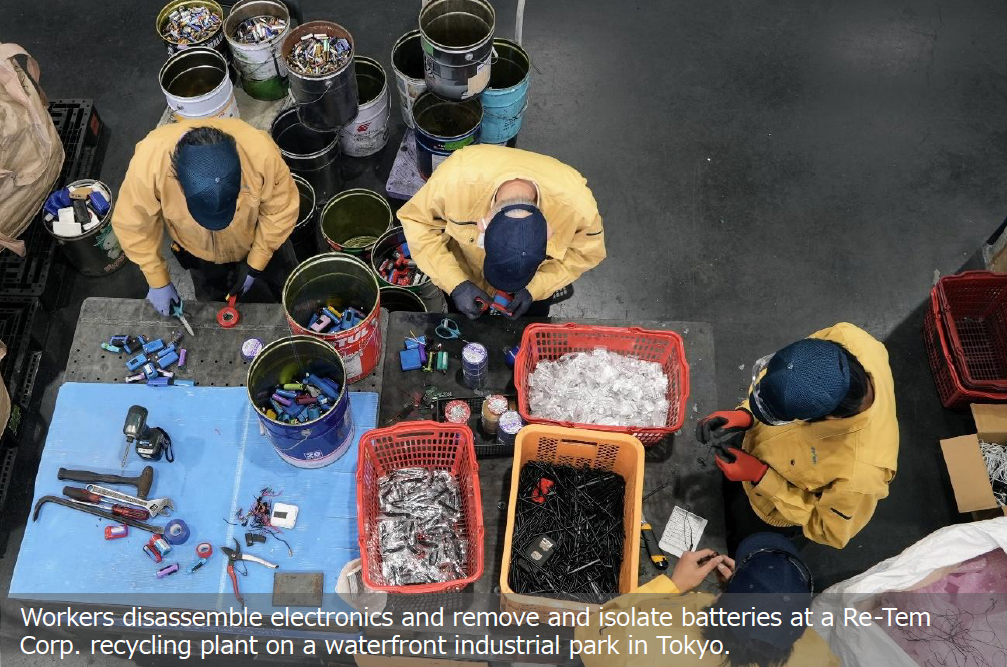
Workers disassemble electronics and remove and isolate batteries at a Re-Tem Corp. recycling plant on a waterfront industrial park in Tokyo.

(Left) Visitors to the Tokyo Fire Department’s Ikebukuro Life Safety Learning Center crouch during a magnitude-9 earthquake simulation on a shaking platform. (Right) A diagram shows how an earthquake occurs.

Yanagida Yoshitaka, MPD Traffic Control Center’s chief inspector, explains how the center’s main operation room works to foreign journalists on a media tour.
TOKYO, JAPAN, November 27, 2026 /EINPresswire.com/ -- Magnitude-9 earthquake simulations preparing residents and visitors alike for the “big one.” Olympic and Paralympic medals made of metals extracted from electronics no longer in use. These are just a few of the initiatives Tokyo has been driving in order to build a resilient and sustainable megacity.
Disaster preparedness and resource recycling may be foremost among the city-building challenges for Tokyo, one of the world’s most populous and vibrant metropolises. And safe and smooth road traffic should be ensured day and night for the Japanese capital teeming with a population of 14 million.
The Tokyo Fire Department provides hands-on quake and fire drills, challenging participants to hold tight against violent shaking and escape through smoke-filled rooms. Tokyo, which rebuilt itself from the ruins of the 1923 Great Kanto Earthquake, is prepared for a megaquake striking directly underneath, which seismologists say is likely in the next 30 years.
A Tokyo Metropolitan Government video promoting its disaster preparedness and traffic control initiatives:
https://www.youtube.com/watch?v=LaMPmgvHAT0
On an industrial park developed in a metropolitan-owned landfill area adjacent to the waterfront Haneda airport, heaps of various kind of waste from across the Greater Tokyo area are recycled into reusable materials—possibly containing gold, silver or other rare metals.
“Resources are buried all around us as untapped mountains of treasure in our everyday lives,” said Tokyo Governor Koike Yuriko. Citing the energy crunch due to Middle East tensions, she noted that the metropolitan government is “working to diversify our supply resources and rapidly promote innovation.” Her remarks were made at a panel discussion on sustainable development at the United Nations Economic and Social Council in July.
The Metropolitan Police Department centrally monitors and optimizes the flow of vehicles on some 300 major roads across Tokyo around the clock by adjusting the timing of traffic lights. At the Tokyo Metropolitan Traffic Control Center, a huge 5x25-meter (16X82-foot) monitor panel shows traffic conditions at a glance, utilizing input from about 19,000 vehicle detectors.
There are various other urban systems at work—with varying track records—to keep Tokyo ticking. They are consistent with the metropolitan government’s long-term policy framework, “Tokyo 2050 Strategy,” which was formulated in 2025.
The action plan aims to turn Tokyo into a “diverse”, “smart” and “safe” city. One of its key objectives is: “We will evolve Tokyo into a ‘resilient and sustainable city’ that is able to withstand a wide range of risks, including natural disasters and climate change.”
[‘Virtual’ Mine and Oil Field Supporting a Sustainable Tokyo]
At the UN panel discussion, Governor Koike said, “Technological innovation is essential to open up new pathways toward a sustainable society.” She then explained the metropolitan government’s “Tokyo Mine” and “Tokyo Oil Field” projects to promote extracting rare metals from used mobile phones and other electronics, and collecting used household cooking oil to use it as materials for sustainable aviation fuel, biodiesel and other products.
For the Tokyo Olympics and Paralympics staged in 2021, all of the approximately 5,000 gold, silver and bronze medals were produced from metals extracted from unused small household electronic devices and others.
The Tokyo Metropolitan Government (TMG) is also taking various other steps to reinforce the capital’s resilience and sustainability.
It has developed massive “underground regulating reservoirs” that temporarily store torrential rainwater and release it in a controlled manner to prevent flooding. The TMG has been also strengthening the seismic resistance of city water and sewer pipes. It is promoting the production and use of green hydrogen in Tokyo, and the deployment of Japan-developed thin, lightweight and flexible solar cells.
To showcase these forward-looking initiatives worldwide, the TMG organized in September an international media tour of four locations where the action is.
Dubbed “Behind the Scenes of Tokyo,” the press tour visited a waterfront industrial waste recycling plant as well as a Tokyo Fire Department facility promoting disaster preparedness and the Tokyo Metropolitan Traffic Control Center downtown. Its last stop was at the city hall where a campaign was underway to collect small rechargeable electronics no longer in use.
[Metal Recycling at the Backbone of a Circular Economy]
The tour group first headed to the Tokyo Super Eco Town, an industrial park developed by the metropolitan government on its land and allocated for companies to treat and recycle various kinds of waste from across the metropolis. Located on two landfill islands in the Port of Tokyo, the complex has accommodated 12 facilities since 2004 with the aim of transforming the capital into a circular economy.
They visited the Tokyo plant of Re-Tem Corp., a company that has specialized in resource recovery and recycling for almost 120 years since its founding, which is now headed by its sixth-generation president, Nakajima Sachiyo. She said that a huge amount of waste is generated in Tokyo every day, which needs to be processed quickly and efficiently, and that Re-Tem has large shredders. “Our selling point is that we can recycle metallic waste from the metropolitan area while the process can be sped up as we are located in Tokyo.”
The company was founded in 1909 in Mito, a provincial city northeast of Tokyo, and reportedly processed scrap iron from local factories in its early years. Re-Tem established its Tokyo base in 1952 and launched a plant on the industrial complex in 2005.
At the Tokyo factory, chunks of urban waste are crushed and sorted out into ferrous and non-ferrous metals, and plastics and other materials. “We leave it to non-ferrous refineries to recover gold, silver, copper and other rare metals—platinum and palladium in some cases,” a senior Re-Tem official said. Re-Tem has also expanded its business to collect and recycle small household electronics since 2013.
The plant can process a maximum 864 tons of waste every day, if operated at full capacity for 24 hours. Currently, it operates for 8 hours per day with around 100 tons of waste brought in every day. It is equipped with solar panels and buys renewable energy from the metropolitan government in an effort to reduce carbon dioxide emissions, she said. Re-Tem Corp. took part in Tokyo Olympic and Paralympic medal production using recycled metals.
[An Earthquake May Strike ‘While You Are Eating’]
The tour group moved on to the downtown shopping and entertainment hub of Ikebukuro, exploring a Fire Department facility dedicated to disaster preparedness—an arrangement deemed necessary in earthquake-prone Japan.
At the facility called the Ikebukuro Life Safety Learning Center, visitors are encouraged to relive the rumbling of the magnitude-9 megaquake, which triggered a massive tsunami and left over 20,000 people dead or missing along the eastern Japan coast in March 2011. Also on the center’s menu were other hands-on experiences including fire-smoke evacuation, firefighting and first-aid practices.
One foreign journalist asked if it was all right to participate in the drill right after having a Cajun chicken sandwich for lunch. “There is no telling when an earthquake may strike,” instructor Akiyama Yukie replied. “It can happen even while you're eating. So, be sure to give it a try today.”
The participants, divided into groups of four, got down on both knees and crouched to protect the head for about 40 seconds on a shaking platform. Ms. Akiyama reminded them that the real 2011 catastrophe had caused the earth to “pitch and roll” for over three minutes—and that this platform was geared to move only horizontally due to structural constraints. “It was much more than this,” she quoted a quake survivor recalling his 2011 experience.
Some 56,000 people participated in safety programs at the facility in the last fiscal year, according to the center’s director, Utashiro Tsubasa. They included new company employees on onboarding sessions and students at Japanese-language institutes. “There are foreign nationals including residents in Tokyo. We encourage them to especially acquire the knowledge and skills necessary to protect their lives,” he said.
The 40-year-old facility also interacts with neighborhood associations in promoting disaster drills. The Tokyo Fire Department runs two other similar facilities, each complete with earthquake simulations.
[An “Excellent” Driver-Friendly Traffic Information System]
The media tour then moved to another downtown hub, Shimbashi, to check out the nerve center of urban traffic control. A huge wall-mounted monitor panel dominates the Metropolitan Police Department’s Traffic Control Center main operation room, which is staffed by teams of three controllers on three shifts around the clock.
The panel, 5 meters high and 25 meters wide, split into three screens. The left screen shows traffic conditions on the Metropolitan Expressway network and its connecting highways. The largest central screen monitors conditions on some 300 regular roads totaling 3,280 kilometers in length.
The right screen displays accident information based on on-the-spot reports and images from about 1,000 cameras at 400 spots monitoring the roads. Radio networks have booths in the operation room and broadcast real-time developments in traffic accidents.
When the 2011 Great East Japan Earthquake struck, all highways were closed and all train runs halted in Tokyo because an intense tremor was also felt there, according to the center’s chief inspector, Yanagida Yoshitaka. A traffic shutdown drill is held every year on September 1, the day the 1923 Great Kanto Earthquake occurred, he said.
“We are focused on providing information to drivers as quickly as possible (in accident situations),” said Tokyo Metropolitan Traffic Control Center Superintendent Kikuchi Nobuhisa. “I believe our system for collecting and providing information is quite excellent.”
For example, the control center can relay traffic information, which is gathered by optical beacon vehicle detectors placed along roads, to in-car dashboard navigation systems.
Mr. Kikuchi noted that the 52-year-old center has been conducting experiments for about five years to see if artificial intelligence can replace the existing highly advanced computer and prove more effective in controlling the traffic system.
[Digging Up the Oil and Mine Fields in Homes]
The media tour wrapped up at the main Tokyo Metropolitan Government (TMG) building in the western hub of Shinjuku, with environmental officials explaining the latest phases of “Tokyo Mine” and “Tokyo Oil Field” recycling projects.
In a Tokyo Mine campaign for three months until September 30, the TMG collected about 16,000 small rechargeable electronics through a box that can sort them out by using AI. The box was set up on the first floor of the TMG No.1 Building.
The AI-powered collection box sorted out electronic devices into four categories: mobile phones, mobile batteries, electronic cigarettes and others. It safely removed fire-prone lithium-ion batteries from them. “We hand over the sorted items to recycling companies, which then recycle them into materials such as gold, silver, copper and rare metals,” said an official at the TMG Bureau of Environment.
The campaign to collect used household cooking oil, which was launched in conjunction with the 2025 World Athletics Championships in Tokyo, gathered some 11,300 liters from about 80 collection points across Tokyo in almost six months from May to October 2025. The collected oil was refined into so-called Sustainable Aviation Fuel (SAF)—enough to power a flight from Tokyo to New York City.
In a fresh campaign as part of the Tokyo Oil Field project from October 5-25, the TMG collected used household cooking oil at five outlets of a major supermarket chain. The TMG is continuing the Tokyo Oil Field project at places such as supermarkets, large condominiums and municipal facilities. The collected oil will be refined into not only aviation fuel but also printing ink, biofuel, soap for removing dirt and other products.
Tokyo Governor Koike said in late September when she announced the new campaign: “Let's all work together to dig up the Tokyo Oil Field lying dormant in our homes.”
Strategic PR Section, Strategic PR Division
TOKYO METROPOLITAN GOVERNMENT
Legal Disclaimer:
EIN Presswire provides this news content "as is" without warranty of any kind. We do not accept any responsibility or liability for the accuracy, content, images, videos, licenses, completeness, legality, or reliability of the information contained in this article. If you have any complaints or copyright issues related to this article, kindly contact the author above.
