

The Building Is the Common Ground: Lightning Protection Institute (LPI) Launches Its First-Ever Risk Assessment Week
LPI Risk Assessment Week makes the case that resiliency starts in the same place for every trade: a risk assessment at design, revisited throughout the structure's life cycle.
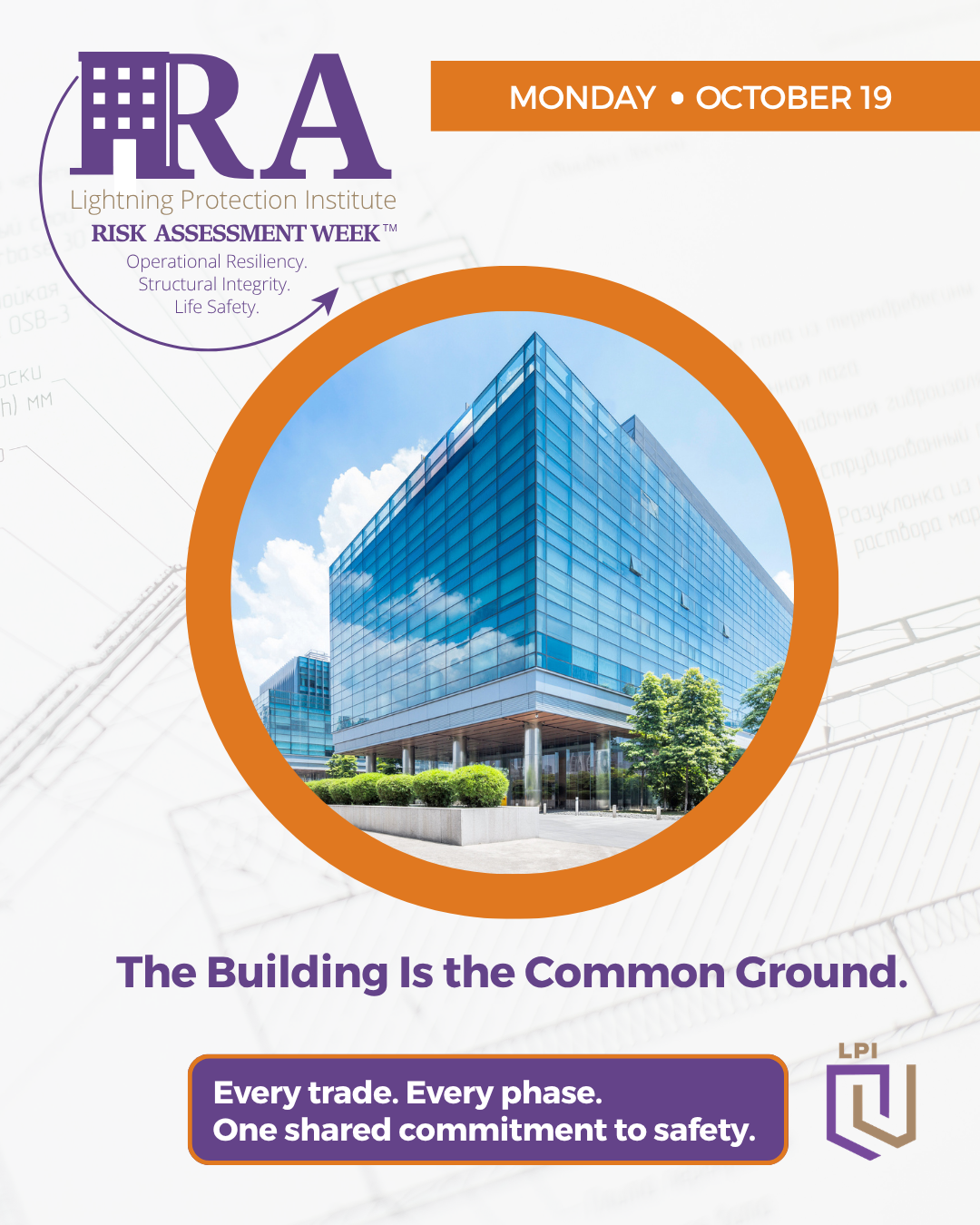
The Building Is the Common Ground for all trades to collaborate on structural integrity and life safety decisions.
Advancing recognized standards, professional certification and education for the design, installation, inspection and maintenance of lightning protection systems
A week-long initiative invites the wider building community to make risk assessment a shared starting point for resiliency and life safety.
From essential facilities to schools and office buildings, every structure has a risk picture worth assessing. For lightning, damage rarely stops at the structure itself; it can reach electrical and electronic systems, communications, operations and the essential services people depend on. Resilience is the theme running through nearly every conversation in the design-build community today, and in the communities those structures serve.
LPI Risk Assessment Week makes the case that resiliency starts in the same place for every trade: a risk assessment at design, revisited throughout the structure's life cycle.
Grounded in proven science and established standards. Lightning protection doesn't begin with assumptions. It is guided by proven science, established standards and codes, and a structured evaluation of risk. From risk assessment through design and installation, the industry relies on that science and those standards, including NFPA 780, IEC 62305 and UL 96A. LPI Risk Assessment Week reinforces the importance of evaluating lightning risk within that framework.
"Operational resiliency, structural integrity and life safety aren't the work of any one trade," said Tim Harger, executive director of the Lightning Protection Institute. "Owners, architects, engineers, contractors, roofers, building enclosure consultants, facility managers, insurers and lightning protection professionals all share a common goal: a safe, resilient building. Each of us plays a different role and understands a different part of the risk. When we work together, the outcome is stronger."
Over five days, LPI will look at risk assessment from the perspective of each group that has a hand in a structure's safety and resilience.
ESSENTIAL FACILITIES. Hospitals, fire stations, 911 centers and water treatment plants keep a community running. People count on them whenever they need care, help or clean water, so these facilities can't afford downtime. A risk assessment asks not only what can be damaged, but what happens if a facility can't operate for a day, a week or longer. Lightning adds one more risk to that picture, which is why a lightning risk assessment belongs at the top of the list when these facilities are designed and maintained.
ARCHITECTS and ENGINEERS. A lightning risk assessment belongs in the earliest design conversations, not after the building is up. Assessing risk at design protects the building and the people inside it, and reduces the damage and downtime a strike can cause.
FACILITY MANAGERS. The assessment doesn't stop when the drawings are done. Facility managers carry it forward for the life of the structure. A renovation, a new roof, a change in use, or a storm or strike can all change the risk. Reassessing at those moments leads to appropriate, timely maintenance and to adjustments as the building changes, and that continual cycle of assessment and maintenance is what keeps a facility safe and resilient.
INSURANCE. Insurers have assessed and priced risk for centuries, and they look at the whole life of a structure because that is the whole life of the risk they carry. A documented lightning risk assessment is a first step in mitigating that risk early, limiting loss and supporting insurability.
From assessment to action. A structured lightning risk assessment considers the property, its use, its environment and the consequences of disruption or loss. When protection is warranted, the path forward includes standards-based design, qualified installation, independent inspection and ongoing maintenance.
The week closes with a recap and practical tools, including a checklist of what goes into a lightning risk assessment, so every discipline can ask the right questions on its next project.
LPI invites professionals across the building community to follow the series on LinkedIn and Facebook, share the posts with their teams, and use the week's resources on their own projects.
EVERY TRADE. EVERY PHASE. One shared commitment to safety.
Learn more: Find LPI's articles, case studies and technical resources at lightning.org/resources. The risk assessment checklist will be shared through LPI's posts during the week. For questions about lightning risk assessment, contact LPI at lpi@lightning.org or 800.488.6864.
About the Lightning Protection Institute
The Lightning Protection Institute (LPI) advances recognized standards, professional certification and education for the design, installation, inspection and maintenance of lightning protection systems. Founded in 1955, LPI represents the professionals and companies that make up the lightning protection industry, including manufacturers, certified contractors and installers, engineers, architects and technical experts. LPI works across the building industry, sharing guidance and practical resources with every trade. Together, we help protect people, structures and communities, supporting operational resiliency, structural integrity and life safety. Learn more at lightning.org.
Lightning Protection Institute
LPI
+1 800-488-6864
Visit us on social media:
LinkedIn
Instagram
Facebook
Legal Disclaimer:
EIN Presswire provides this news content "as is" without warranty of any kind. We do not accept any responsibility or liability for the accuracy, content, images, videos, licenses, completeness, legality, or reliability of the information contained in this article. If you have any complaints or copyright issues related to this article, kindly contact the author above.
