Complete Procurement Guide from the Best Milk Thistle Extract Bulk Supplier in China
XI'AN, SHAANXI, CHINA, July 12, 2026 /EINPresswire.com/ -- For procurement managers in the pharmaceutical, nutraceutical, and nutritional supplement industries, sourcing high-quality botanical ingredients involves navigating hidden operational hurdles. When purchasing bulk milk thistle extract derived from Silybum marianum seeds, standard specifications on paper do not always translate to seamless manufacturing. Common challenges during production scale-up include the artificial inflation of total flavonolignans, unexpected residual solvents from aggressive extraction, unmapped heavy metals, and significant color variations between evaluation samples and commercial batches.
To mitigate these risks and stabilize production lines, raw material buyers utilize a strict five-step verification checklist. This framework covers active constituent standardization, extraction solvent purity, comprehensive contaminant screening, certified organic traceability, and large-scale delivery consistency. Utilizing a verified processing infrastructure, such as the one maintained by Xi'an Demeter Biotech Co., Ltd., helps technical teams address each stage of this quality framework.
Xi'an Demeter Biotech Co., Ltd, operates a dedicated production system optimized for natural botanical extracts, organic fruit and vegetable powders, and functional food ingredients. By aligning processing workflows with systematic verification steps, international buyers can secure predictable material behaviors for their final supplement or pharmaceutical formulations. Sourcing from a reliable, verified Best Milk Thistle Extract Bulk Supplier provides the necessary technical documentation and processing transparency required to satisfy modern international compliance protocols.
Step 1: Verification of Active Constituent Standardization
The foundation of any botanical procurement process is the exact calibration of active markers. Milk thistle extract relies primarily on a group of flavonolignans collectively known as silymarin, with silybin acting as the principal active component responsible for the herb's functional properties. A frequent error in raw material procurement is relying on single-method assays that can misrepresent actual chemical profiles.
To prevent formulation discrepancies, technical buyers require dual-method documentation on every Certificate of Analysis (COA). The standard market specification requires a verification showing silymarin at 80% via Ultraviolet-Visible (UV-Vis) spectrophotometry, paired with a specific silybin concentration of 30% verified through High-Performance Liquid Chromatography (HPLC). This multi-layered analytical approach confirms that the active compounds are genuinely derived from authentic Silybum marianum seeds rather than external adulterants or lower-grade plant parts. Xi'an Demeter Biotech Co., Ltd. provides comprehensive COA documentation for its plant extract range, matching both UV and HPLC metrics to establish a baseline of chemical identity and purity before any material leaves the facility.
Step 2: Extraction Solvent and Process Transparency
The methods used to isolate silymarin from the dense matrix of milk thistle seeds directly influence the safety and regulatory compliance of the final ingredient. Industrial extraction often relies on harsh synthetic solvents to maximize yield at the expense of purity, leaving chemical residues that fail strict international pharmacopeia limits.
Modern nutraceutical manufacturing demands clean processing systems. Qualified production facilities utilize a refined water and food-grade purified ethanol extraction matrix. This approach aligns with international pharmaceutical and organic processing guidelines, keeping residual solvents well within acceptable parts-per-million limits. Furthermore, the physical environment where extraction takes place must be strictly controlled. Within the manufacturing plants of Demeterherb, production zones are strictly partitioned under established Good Manufacturing Practice (GMP) standards. This physical separation prevents cross-contamination between different botanical runs, ensuring that the milk thistle extract batch retains its specific sensory characteristics and chemical composition.
Step 3: Comprehensive Screening for Contaminants and Microorganisms
Raw agricultural materials like milk thistle seeds are naturally exposed to environmental elements, making them susceptible to heavy metals, persistent agricultural chemicals, and microbial growth. A standard, basic laboratory panel is often insufficient for brands distributing products in highly regulated markets.
A robust quality protocol demands deep-scan laboratory monitoring. For bulk milk thistle extract, this includes specific quantification of heavy metals, ensuring that lead, arsenic, mercury, and cadmium remain far below international safety thresholds. Additionally, extensive multi-residue pesticide screens covering over 660 distinct compounds are necessary to confirm agricultural purity. Microbial controls must enforce strict limits on total plate counts, yeasts, molds, and specific pathogens such as E. coli and Salmonella. Demeterherb applies these rigorous testing protocols uniformly across its entire GMP-compliant production framework, mirroring the precise quality controls utilized for its delicate organic matcha powder lines. To provide independent verification, the company supports these internal metrics with third-party testing data from internationally recognized testing bodies such as SGS or Eurofins.
Step 4: Organic Compliance and Traceability Structures
As consumer preferences lean toward simpler, clean-label formulations, raw material traceability has transitioned from an optional marketing tool to a core procurement requirement. Buyers must verify that the agricultural ingredients can be traced back through transparent supply chains to documented cultivation fields.
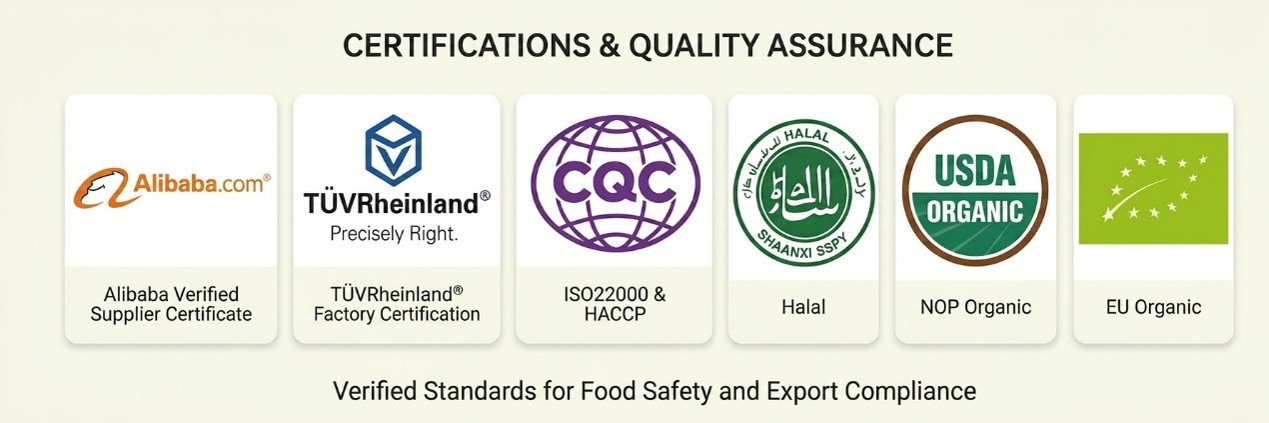
Maintaining international organic certifications confirms this level of control. Production facilities must hold valid certifications such as European Union Organic (EU Organic) and the National Organic Program (NOP) standards from the United States Department of Agriculture. These frameworks prove that no synthetic fertilizers, prohibited pesticides, or genetically modified organisms were used during cultivation or processing. By maintaining independent import and export rights alongside these organic credentials, Demeterherb secures an uninterrupted chain of custody from regional farming partners directly to international logistics hubs, allowing global brands to fulfill their domestic transparency and labeling obligations.
Step 5: Large-Scale Delivery and Logistics Consistency
The final stage of the procurement checklist addresses the transition from laboratory samples to bulk commercial shipments. A high-quality sample loses its value if the subsequent multi-ton order exhibits variations in solubility, particle size, or bulk density, or if it encounters delays during international transit.
Mitigating these logistical risks requires a combination of structured factory oversight and robust transport networks. Having expanded its international trade footprint to more than 50 countries, the experienced teams at Demeterherb utilize established partnerships across multiple transport modes, including air, sea, rail, and express courier networks. This logistical infrastructure ensures that milk thistle extract bulk shipments maintain physical and chemical consistency across large volumes. Operating under certified ISO9001 and ISO22000 quality management systems, the factory ensures that commercial batches match the exact technical specifications established during initial product evaluation.
Selecting a Long-Term Manufacturing Partner
Procuring dependable botanical ingredients requires balancing technical precision with stable manufacturing capacity. The ideal milk thistle extract bulk supplier must provide more than raw powder; they must deliver consistent active marker ratios, transparent solvent processing, complete contaminant screening, and recognized organic certifications.
Xi'an Demeter Biotech Co., Ltd. addresses these industrial requirements through its GMP-compliant manufacturing facilities, comprehensive TÜV Rheinland factory certifications, and diverse product catalog spanning active pharmaceutical ingredients, liposomal nutrients, and specialized plant extracts. By focusing on verified product safety, verified efficacy, and logistical reliability, the company provides nutritional supplement, cosmetic, and beverage manufacturers in the Americas, Asia, and Europe with a stable foundation for their commercial product lines.
To review complete technical data sheets, request evaluation samples, or consult with an experienced sales representative regarding specific formulation needs, global procurement professionals can connect directly with the production team by visiting the official corporate website at https://www.demeterherb.com/
To mitigate these risks and stabilize production lines, raw material buyers utilize a strict five-step verification checklist. This framework covers active constituent standardization, extraction solvent purity, comprehensive contaminant screening, certified organic traceability, and large-scale delivery consistency. Utilizing a verified processing infrastructure, such as the one maintained by Xi'an Demeter Biotech Co., Ltd., helps technical teams address each stage of this quality framework.
Xi'an Demeter Biotech Co., Ltd, operates a dedicated production system optimized for natural botanical extracts, organic fruit and vegetable powders, and functional food ingredients. By aligning processing workflows with systematic verification steps, international buyers can secure predictable material behaviors for their final supplement or pharmaceutical formulations. Sourcing from a reliable, verified Best Milk Thistle Extract Bulk Supplier provides the necessary technical documentation and processing transparency required to satisfy modern international compliance protocols.
Step 1: Verification of Active Constituent Standardization
The foundation of any botanical procurement process is the exact calibration of active markers. Milk thistle extract relies primarily on a group of flavonolignans collectively known as silymarin, with silybin acting as the principal active component responsible for the herb's functional properties. A frequent error in raw material procurement is relying on single-method assays that can misrepresent actual chemical profiles.
To prevent formulation discrepancies, technical buyers require dual-method documentation on every Certificate of Analysis (COA). The standard market specification requires a verification showing silymarin at 80% via Ultraviolet-Visible (UV-Vis) spectrophotometry, paired with a specific silybin concentration of 30% verified through High-Performance Liquid Chromatography (HPLC). This multi-layered analytical approach confirms that the active compounds are genuinely derived from authentic Silybum marianum seeds rather than external adulterants or lower-grade plant parts. Xi'an Demeter Biotech Co., Ltd. provides comprehensive COA documentation for its plant extract range, matching both UV and HPLC metrics to establish a baseline of chemical identity and purity before any material leaves the facility.
Step 2: Extraction Solvent and Process Transparency
The methods used to isolate silymarin from the dense matrix of milk thistle seeds directly influence the safety and regulatory compliance of the final ingredient. Industrial extraction often relies on harsh synthetic solvents to maximize yield at the expense of purity, leaving chemical residues that fail strict international pharmacopeia limits.
Modern nutraceutical manufacturing demands clean processing systems. Qualified production facilities utilize a refined water and food-grade purified ethanol extraction matrix. This approach aligns with international pharmaceutical and organic processing guidelines, keeping residual solvents well within acceptable parts-per-million limits. Furthermore, the physical environment where extraction takes place must be strictly controlled. Within the manufacturing plants of Demeterherb, production zones are strictly partitioned under established Good Manufacturing Practice (GMP) standards. This physical separation prevents cross-contamination between different botanical runs, ensuring that the milk thistle extract batch retains its specific sensory characteristics and chemical composition.
Step 3: Comprehensive Screening for Contaminants and Microorganisms
Raw agricultural materials like milk thistle seeds are naturally exposed to environmental elements, making them susceptible to heavy metals, persistent agricultural chemicals, and microbial growth. A standard, basic laboratory panel is often insufficient for brands distributing products in highly regulated markets.
A robust quality protocol demands deep-scan laboratory monitoring. For bulk milk thistle extract, this includes specific quantification of heavy metals, ensuring that lead, arsenic, mercury, and cadmium remain far below international safety thresholds. Additionally, extensive multi-residue pesticide screens covering over 660 distinct compounds are necessary to confirm agricultural purity. Microbial controls must enforce strict limits on total plate counts, yeasts, molds, and specific pathogens such as E. coli and Salmonella. Demeterherb applies these rigorous testing protocols uniformly across its entire GMP-compliant production framework, mirroring the precise quality controls utilized for its delicate organic matcha powder lines. To provide independent verification, the company supports these internal metrics with third-party testing data from internationally recognized testing bodies such as SGS or Eurofins.
Step 4: Organic Compliance and Traceability Structures
As consumer preferences lean toward simpler, clean-label formulations, raw material traceability has transitioned from an optional marketing tool to a core procurement requirement. Buyers must verify that the agricultural ingredients can be traced back through transparent supply chains to documented cultivation fields.
Maintaining international organic certifications confirms this level of control. Production facilities must hold valid certifications such as European Union Organic (EU Organic) and the National Organic Program (NOP) standards from the United States Department of Agriculture. These frameworks prove that no synthetic fertilizers, prohibited pesticides, or genetically modified organisms were used during cultivation or processing. By maintaining independent import and export rights alongside these organic credentials, Demeterherb secures an uninterrupted chain of custody from regional farming partners directly to international logistics hubs, allowing global brands to fulfill their domestic transparency and labeling obligations.
Step 5: Large-Scale Delivery and Logistics Consistency
The final stage of the procurement checklist addresses the transition from laboratory samples to bulk commercial shipments. A high-quality sample loses its value if the subsequent multi-ton order exhibits variations in solubility, particle size, or bulk density, or if it encounters delays during international transit.
Mitigating these logistical risks requires a combination of structured factory oversight and robust transport networks. Having expanded its international trade footprint to more than 50 countries, the experienced teams at Demeterherb utilize established partnerships across multiple transport modes, including air, sea, rail, and express courier networks. This logistical infrastructure ensures that milk thistle extract bulk shipments maintain physical and chemical consistency across large volumes. Operating under certified ISO9001 and ISO22000 quality management systems, the factory ensures that commercial batches match the exact technical specifications established during initial product evaluation.
Selecting a Long-Term Manufacturing Partner
Procuring dependable botanical ingredients requires balancing technical precision with stable manufacturing capacity. The ideal milk thistle extract bulk supplier must provide more than raw powder; they must deliver consistent active marker ratios, transparent solvent processing, complete contaminant screening, and recognized organic certifications.
Xi'an Demeter Biotech Co., Ltd. addresses these industrial requirements through its GMP-compliant manufacturing facilities, comprehensive TÜV Rheinland factory certifications, and diverse product catalog spanning active pharmaceutical ingredients, liposomal nutrients, and specialized plant extracts. By focusing on verified product safety, verified efficacy, and logistical reliability, the company provides nutritional supplement, cosmetic, and beverage manufacturers in the Americas, Asia, and Europe with a stable foundation for their commercial product lines.
To review complete technical data sheets, request evaluation samples, or consult with an experienced sales representative regarding specific formulation needs, global procurement professionals can connect directly with the production team by visiting the official corporate website at https://www.demeterherb.com/
Xi'an Demeter Biotech Co., Ltd.
Demeterherb
+86 13379289277
email us here
Visit us on social media:
LinkedIn
Facebook
X
Legal Disclaimer:
EIN Presswire provides this news content "as is" without warranty of any kind. We do not accept any responsibility or liability for the accuracy, content, images, videos, licenses, completeness, legality, or reliability of the information contained in this article. If you have any complaints or copyright issues related to this article, kindly contact the author above.