

Sushi Restaurants Market Drivers 2026-2030: Regional Outlook and Sizing Analysis

Sushi Restaurants Market insights
Sushi Restaurants Market Size

Sushi Restaurants Market Segmentation
The Business Research Company's Sushi Restaurants Market Drivers 2026-2030: Regional Outlook and Sizing Analysis
LONDON, GREATER LONDON, UNITED KINGDOM, April 28, 2026 /EINPresswire.com/ -- "Sushi Restaurants market to surpass $24 billion in 2030. In comparison, the Limited-Service Restaurants market, which is considered as its parent market, is expected to be approximately $2,039 billion by 2030, with Sushi Restaurants to represent around 1% of the parent market. Within the broader Hospitality industry, which is expected to be $7,475 billion by 2030, the Sushi Restaurants market is estimated to account for nearly 0.3% of the total market value.
Which Will Be The Biggest Region In The Sushi Restaurants Market In 2030?
Asia-Pacific will be the largest region in the sushi restaurants market in 2030, valued at $13 billion. The market is expected to grow from $9 billion in 2025 at a compound annual growth rate (CAGR) of 7%. The strong growth can be attributed to the high domestic consumption of sushi in Japan, rapid expansion of quick-service and conveyor belt sushi chains across China and Southeast Asia, rising premium dining culture in developed markets such as Australia, increasing presence of sushi outlets in shopping malls, airports, and transit hubs, advancements in seafood supply chains and cold storage infrastructure enabling wider geographic reach, and growing adoption of automation technologies in sushi preparation improving operational efficiency and scalability across the region.
Which Will Be The Largest Country In The Global Sushi Restaurants Market In 2030?
Japan will be the largest country in the sushi restaurants market in 2030, valued at $7 billion. The market is expected to grow from $5 billion in 2025 at a compound annual growth rate (CAGR) of 6%. The strong growth can be attributed to deep-rooted culinary traditions and craftsmanship standards, strong domestic demand for premium omakase and specialty dining experiences, high density of independent sushi establishments, increasing innovation in traditional preparation techniques, growing focus on sustainability in seafood sourcing, and strong integration of sushi culture into everyday dining habits across the country.
Request A Free Sample Of The Sushi Restaurants Market Report
https://www.thebusinessresearchcompany.com/sample_request?id=25114&type=smp&utm_source=EINPresswire&utm_medium=Paid&utm_campaign=Apr_PR
What Will Be The Largest Segment In The Sushi Restaurants Market In 2030?
The sushi restaurants market is segmented by type into single sushi restaurants and conveyor belt sushi restaurants. The single sushi restaurant market will be the largest segment of the sushi restaurants market segmented by type, accounting for 53% or $13 billion of the total in 2030. The single sushi restaurant market will be supported by strong emphasis on chef-driven dining experiences, increasing demand for customized meal preparation and omakase-style offerings, higher flexibility in menu design and ingredient sourcing, growing appeal of niche and specialty sushi concepts, rising demand for premium-quality seafood and artisanal preparation, and ability to differentiate through brand identity and customer engagement.
The sushi restaurants market is segmented by restaurant size into small and medium sushi bars, large scale restaurants, boutique sushi cafes, and fine dining. The small and medium sushi bars market will be the largest segment of the sushi restaurants market segmented by restaurant size, accounting for 43% or $10 billion of the total in 2030. The small and medium sushi bars market will be supported by efficient operational models with lower capital investment, strong adaptability to local customer preferences, higher location flexibility in urban and suburban areas, faster service turnaround times, strong customer loyalty driven by personalized interactions, and ability to operate in high-density urban environments with limited space.
The sushi restaurants market is segmented by consumer preferences into dine-in, takeaway, and delivery. The dine-in market will be the largest segment of the sushi restaurants market segmented by consumer preferences, accounting for 66% or $16 billion of the total in 2030. The dine-in market will be supported by the experiential nature of sushi preparation and presentation, increasing demand for chef interaction and live preparation formats, strong appeal of ambiance and cultural dining settings, higher average ticket sizes compared to off-premise consumption, integration of experiential dining concepts such as omakase counters, and growing demand for social dining experiences.
The sushi restaurants market is segmented by applications into local market and international chain market. The local market will be the largest segment of the sushi restaurants market segmented by applications, accounting for 63% or $15 billion of the total in 2030. The local market will be supported by strong neighborhood-based dining ecosystems, higher frequency of repeat customers, flexibility in adapting menus to regional tastes, strong relationships with local suppliers, increasing popularity of community-driven dining experiences, and ability to maintain cost efficiency through localized operations.
The sushi restaurants market is segmented by end-user into residential and commercial. The commercial market will be the largest segment of the sushi restaurants market segmented by end-user, accounting for 78% or $19 billion of the total in 2030. The commercial market will be supported by strong demand from hospitality and tourism sectors, increasing presence of sushi offerings in hotels and premium dining venues, expansion of sushi formats in high-traffic commercial locations, growing adoption of catering services for corporate events, increasing partnerships with foodservice operators, and strong focus on scalability and operational efficiency in commercial dining environments.
What Is The Expected CAGR For The Sushi Restaurants Market Leading Up To 2030?
The expected CAGR for the sushi restaurants market leading up to 2030 is 7%.
What Will Be The Growth Driving Factors In The Global Sushi Restaurants Market In The Forecast Period?
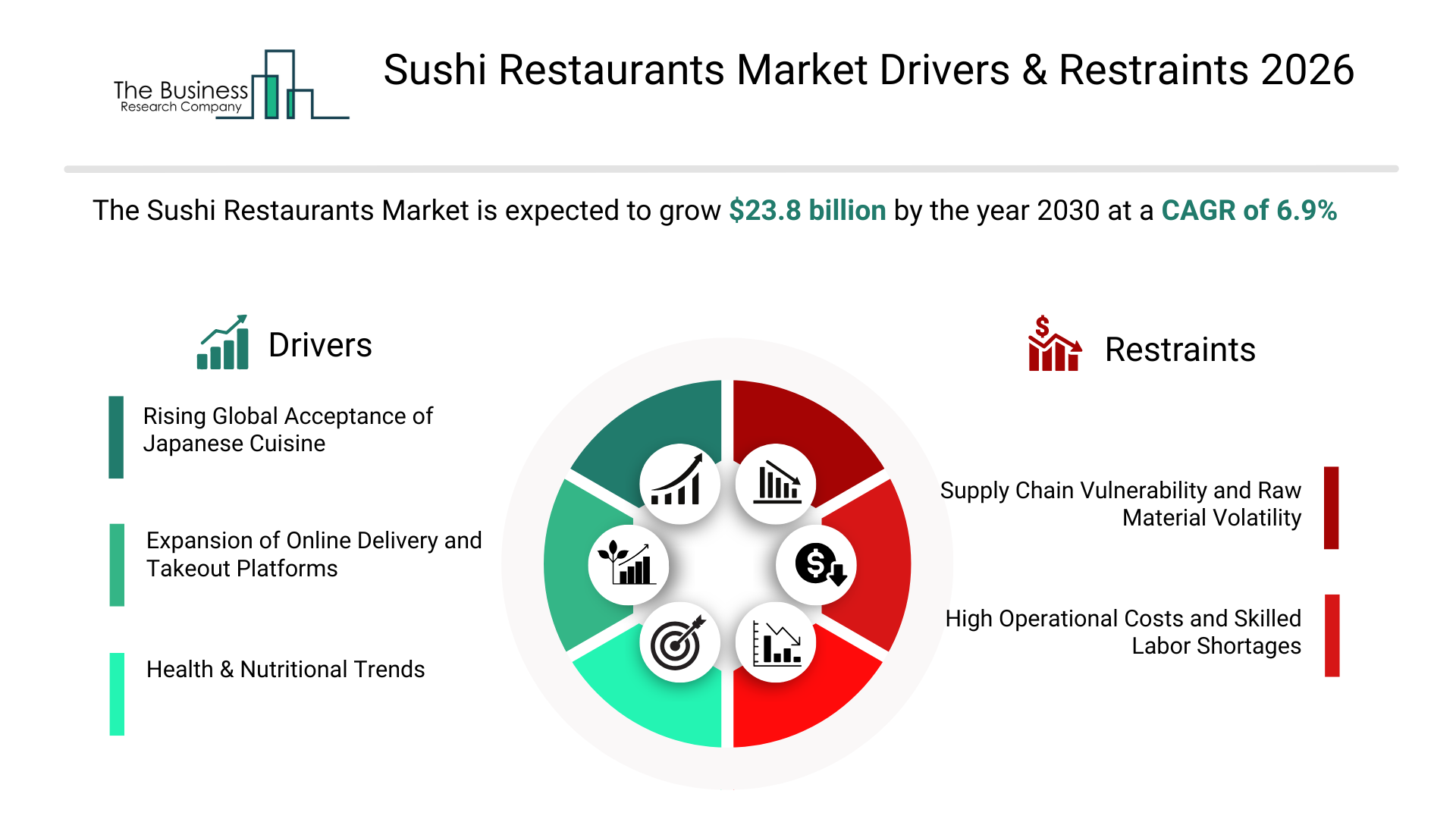
The rapid growth of the global sushi restaurants market leading up to 2030 will be driven by the increasing consumer preference for authentic and culturally rooted dining experiences, growing demand for personalized service and freshly prepared sushi, expansion of small and medium sushi bars catering to local tastes, rising popularity of sushi as a healthy and convenient meal option, and innovation in restaurant concepts, delivery models, and digital ordering platforms across global urban and suburban markets.
Rising Global Acceptance Of Japanese Cuisine - The rising global acceptance of Japanese cuisine continues to significantly support the expansion of the sushi restaurants market by 2030. Increasing global familiarity and acceptance of sushi as a mainstream meal option continues to broaden the consumer base beyond traditional markets, with sushi no longer viewed solely as premium or niche dining. Urban lifestyle shifts, combined with cultural globalization through social media, elevate Japanese cuisine’s visibility, boosting dine‑in and delivery demand simultaneously. This widespread acceptance underpins expansion into new geographies and reinforces brand positioning in diverse markets. As a result, the rising global acceptance of Japanese cuisine is anticipated to contribute approximately 2.8% annual growth to the market.
Expansion Of Online Delivery And Takeout Platforms - The expansion of online delivery and takeout platforms is expected to emerge as a major factor driving the expansion of the sushi restaurants market by 2030. The proliferation of digital food delivery platforms and e‑commerce channels increases sushi accessibility conspicuously, allowing outlets to reach time‑pressed, convenience‑oriented consumers. Sushi’s compact format is particularly suitable for delivery, and restaurants are adapting menu packaging and online ordering systems to optimize off‑premise sales. Enhanced last‑mile technology raises overall market penetration and frequency of orders. Consequently, expansion of online delivery and takeout platforms is projected to contribute around 2.5% annual growth to the market.
Health And Nutritional Trends – The health and nutritional trends are expected to act as a key growth catalyst for the sushi restaurants market by 2030. Health awareness among consumers drives preference for sushi, which is broadly perceived as a low–calorie, nutrient‑rich option due to fresh fish, vegetables, and balanced macro‑nutrients. This resonates with younger and health‑focused demographics, sustaining demand in markets where wellness dining choices are prioritized. The trend supports product diversification toward plant‑based and lower‑carb options, expanding addressable segments. Therefore, the health and nutritional trends are projected to contribute approximately 2.0% annual growth to the market.
Access The Detailed Sushi Restaurants Market Report Here
https://www.thebusinessresearchcompany.com/report/sushi-restaurants-global-market-report?utm_source=EINPresswire&utm_medium=Paid&utm_campaign=Apr_PR
What Are The Key Growth Opportunities In The Sushi Restaurants Market in 2030?
The most significant growth opportunities are anticipated in the single sushi restaurant market, and the conveyor belt sushi restaurant market. Collectively, these segments are projected to contribute over $7 billion in market value by 2030, driven by increasing development of scalable sushi restaurant formats, growing adoption of franchise-based expansion models, rising investment in premium and experiential dining concepts, expansion into emerging urban markets, and increasing innovation in restaurant operations and customer engagement strategies. This surge reflects the evolution of diversified dining formats, enhanced operational scalability, and growing global appeal of sushi as a mainstream dining option, fuelling transformative growth within the broader sushi restaurants ecosystem.
The single sushi restaurant market is projected to grow by $3 billion, and the conveyor belt sushi restaurant market by $4 billion over the next five years from 2025 to 2030.
Learn More About The Business Research Company
The Business Research Company (www.thebusinessresearchcompany.com) is a leading market intelligence firm renowned for its expertise in company, market, and consumer research. We have published over 17,500 reports across 27 industries and 60+ geographies. Our research is powered by 1,500,000 datasets, extensive secondary research, and exclusive insights from interviews with industry leaders.
We provide continuous and custom research services, offering a range of specialized packages tailored to your needs, including Market Entry Research Package, Competitor Tracking Package, Supplier & Distributor Package and much more.
Disclaimer: Please note that the findings, conclusions and recommendations that TBRC Business Research Pvt Ltd delivers are based on information gathered in good faith from both primary and secondary sources, whose accuracy we are not always in a position to guarantee. As such TBRC Business Research Pvt Ltd can accept no liability whatever for actions taken based on any information that may subsequently prove to be incorrect. Analysis and findings included in TBRC reports and presentations are our estimates, opinions and are not intended as statements of fact or investment guidance.
Contact Us:
The Business Research Company
Americas +1 310-496-7795
Europe +44 7882 955267
Asia & Others +44 7882 955267 & +91 8897263534
Email: info@tbrc.info
Follow Us On:
LinkedIn: https://in.linkedin.com/company/the-business-research-company"
Oliver Guirdham
The Business Research Company
+44 7882 955267
info@tbrc.info
Visit us on social media:
LinkedIn
Facebook
X
Legal Disclaimer:
EIN Presswire provides this news content "as is" without warranty of any kind. We do not accept any responsibility or liability for the accuracy, content, images, videos, licenses, completeness, legality, or reliability of the information contained in this article. If you have any complaints or copyright issues related to this article, kindly contact the author above.
